
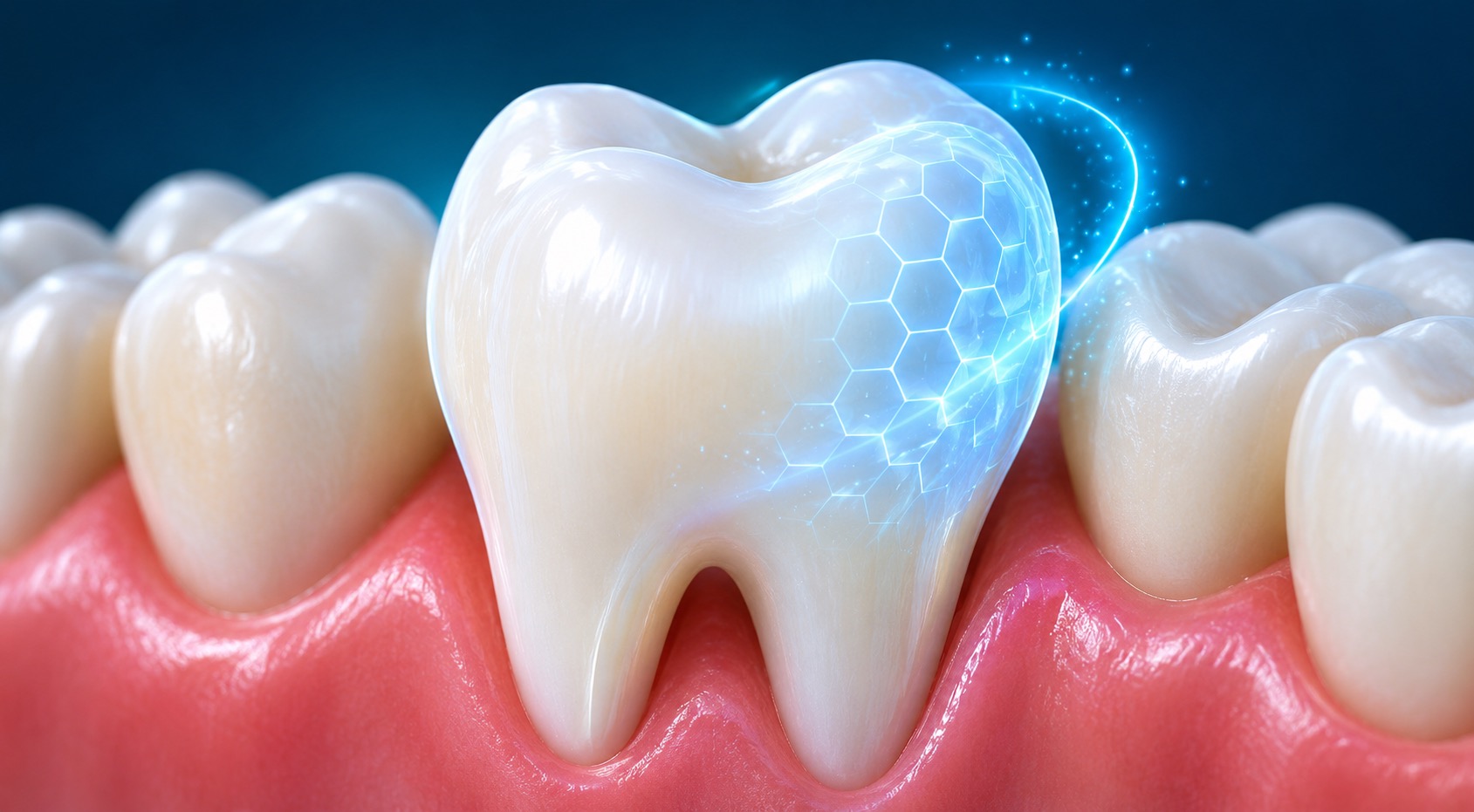

Researchers from the University of Nottingham in the United Kingdom have developed a protein-based material designed to restore the structure and properties of damaged tooth enamel, one of the most important protective layers of human teeth.
The breakthrough could address a longstanding challenge in dentistry: unlike bones and other tissues, tooth enamel cannot naturally regenerate once substantial amounts have been lost.
The research, published in the scientific journal Nature Communications, demonstrates how the new material can encourage the growth of organised mineral crystals that closely resemble the structure of natural enamel.
How Does the Enamel-Regrowing Gel Work?
The newly developed gel works by imitating the natural proteins responsible for guiding enamel formation during early childhood.
When applied to a damaged tooth, the protein-based material forms a thin protective coating that penetrates microscopic cracks and damaged areas.
It then acts as a framework, attracting calcium and phosphate ions naturally found in saliva. These minerals are essential building blocks of tooth enamel.
Through a process known as epitaxial mineralisation, the material encourages new mineral crystals to grow in an organised pattern, integrating with the existing tooth structure.
Unlike conventional remineralisation products that primarily strengthen remaining enamel, the new technology aims to restore the microscopic architecture and mechanical properties of damaged enamel.
Regenerated Enamel Shows Properties Similar to Natural Teeth
The researchers tested the regenerated material under laboratory conditions designed to simulate everyday activities, including tooth brushing, chewing and exposure to acidic foods.
The findings indicated that the regenerated enamel displayed mechanical properties comparable to those of healthy natural enamel.
According to the research team, this could potentially provide a more durable solution for repairing enamel erosion and strengthening weakened teeth.
The material was also found to have potential applications for exposed dentine, the softer layer beneath tooth enamel.
By encouraging the formation of an enamel-like mineral coating over exposed dentine, the technology could eventually help address tooth sensitivity caused by hot, cold or sweet foods and drinks.
Could It Reduce Cavities and the Need for Fillings?
Tooth enamel acts as the first line of defence against bacteria, acids and everyday physical wear.
Once enamel is significantly damaged or lost, the body cannot naturally rebuild the missing structure. Existing treatments, including fluoride varnishes and remineralisation products, can help strengthen remaining enamel and address early mineral loss but cannot fully reconstruct substantial enamel loss.
The newly developed gel could potentially offer another approach to repairing weakened tooth surfaces and protecting teeth against further deterioration.
Researchers believe the technology could eventually be incorporated into professional dental treatments and other oral-care products.
However, it is important to note that the research does not yet establish that the gel can replace conventional fillings or rebuild deep cavities in patients.
When Could the Treatment Become Available?
The research team, led by Professor Alvaro Mata at the University of Nottingham, has been working towards translating the technology into practical dental applications.
The researchers have also established a start-up company, Mintech-Bio, to support the development and commercialisation of the technology.
The University team previously expressed hope that an initial product could become available in 2026. However, commercial availability and regulatory approval should not be assumed.
A small human pilot study is also investigating the treatment for early enamel lesions, but further clinical research is needed to establish its effectiveness, safety and long-term durability in patients.
A Potential New Direction for Dentistry
If successfully developed and validated in clinical practice, the technology could change how dentists approach enamel erosion, early tooth damage and sensitivity.
Rather than simply protecting damaged teeth or replacing missing portions with conventional restorative materials, the approach seeks to encourage the growth of new mineral tissue that closely resembles natural enamel.
While further research is necessary, the discovery represents a promising development in biomaterials and regenerative dentistry, offering hope for future treatments that could help preserve natural teeth for longer.