
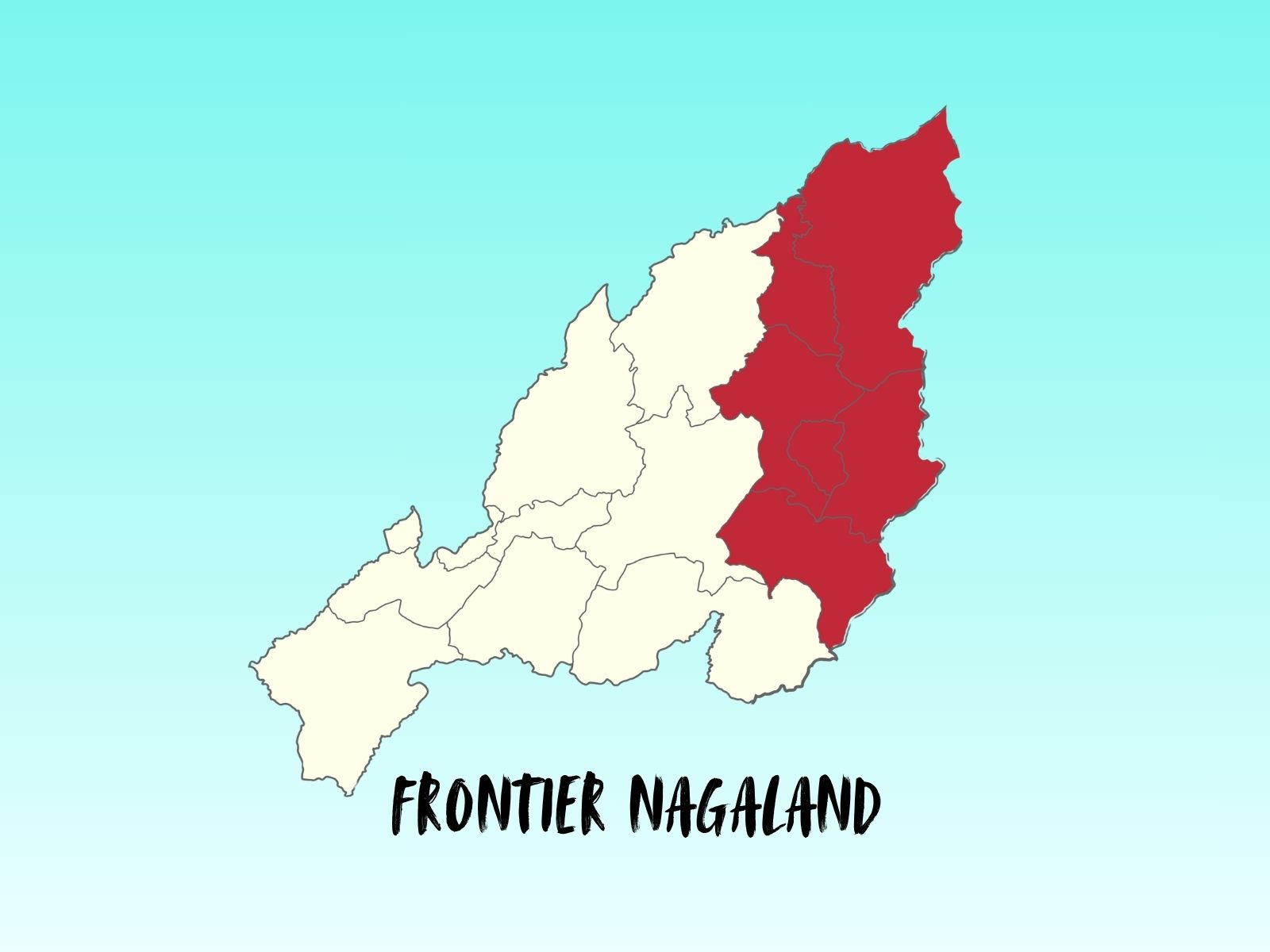

KOHIMA: The Frontier Nagaland Territorial Authority (FNTA) Bill, 2026 proposes a new regional self-governance structure for six districts of eastern Nagaland, with wide-ranging powers over development, education, agriculture, healthcare, tourism, rural development and other subjects.
The revised FNTA Bill was introduced in the Nagaland Legislative Assembly on September 1, 2026, and is scheduled for consideration by the Assembly on September 3. The legislation follows the February 5, 2026 Memorandum of Agreement (MoA) between the Centre, the Nagaland Government and the Eastern Nagaland Peoples’ Organisation (ENPO).
What is the Frontier Nagaland Territorial Authority?
The FNTA is proposed as a regional authority within the State of Nagaland, rather than a separate state or Union Territory.
The proposed Frontier Nagaland Territory will cover six districts:
- Tuensang
- Mon
- Longleng
- Kiphire
- Noklak
- Shamator
The primary objective is to provide greater regional participation in governance and accelerate socio-economic development in eastern Nagaland.
FNTA to have 62 members
The proposed Authority will consist of 62 members.
Of these, 40 members will be directly elected from territorial constituencies. One-third of the elected seats will be reserved for women.
The Governor will nominate two members from recognised tribes that are unrepresented or under-represented in the Authority. These nominated members will have voting rights.
In addition, 20 Nagaland MLAs whose constituencies fall within the Frontier Nagaland Territory will become ex-officio members. However, they will not have voting rights in the FNTA.
The normal term of the elected and nominated members will be five years.
Chief Executive Member to head FNTA
The executive authority of the FNTA will be exercised through an Executive Council of up to nine members.
The Council will be headed by a Chief Executive Member (CEM), assisted by a Deputy Chief Executive Member and other Executive Council members.
The CEM and Deputy CEM will have protocol status equivalent to Cabinet Ministers, while other Executive Council members will have status equivalent to Ministers of State within the Frontier Nagaland Territory.
FNTA to receive powers over 46 subjects
One of the most important provisions of the Bill is the proposed transfer of 46 subjects to the FNTA.
These include agriculture, horticulture, fisheries, non-reserve forests, irrigation, jhum cultivation, primary healthcare, school education up to higher secondary level, skill development, labour and employment, rural development, social welfare, tourism, handloom and handicrafts.
Other areas include youth and sports, veterinary services, water resources, district roads, public transport, housing, tribal affairs, markets and fairs, food and civil supplies, Village Guards, customary courts, fire and emergency services, local taxes and fees, public health engineering, and regional planning and development.
State Government will retain important powers
Despite the proposed transfer of 46 subjects, the FNTA will not have unlimited authority.
Certain powers will remain with the State Government. For example, geology and mining will remain exclusively under the State Government.
Similarly, State-wide tourism projects will remain under the State Government, while tourism projects exclusively within the FNTA area may be handled by the Authority.
Law and order and overall police administration will also remain under the State Government.
FNTA can make laws on transferred subjects
The proposed Authority will have powers to make laws, rules, regulations and orders concerning subjects transferred to it.
However, such laws will require approval through the prescribed State-level process and ultimately the Governor’s assent and publication in the State Gazette.
The Bill also makes clear that existing Central and State laws will continue to apply in the Frontier Nagaland Territory.
Interim Council proposed before elections
Before the elected FNTA is constituted, the State Government may establish an Interim Council consisting of up to 13 members.
The Interim Council will be nominated by the Governor based on recommendations from the ENPO in consultation with the respective Tribal Councils.
The Interim Council can function for a maximum of one year, or until the first elected FNTA is constituted, whichever occurs earlier.
Separate FNTA Secretariat
The Bill proposes a dedicated FNTA Secretariat.
A senior IAS officer, preferably of Additional Chief Secretary rank and not below Principal Secretary rank, will serve as the Chief Executive Secretary.
An Additional Commissioner for District Administration will also be posted at the FNTA headquarters.
However, these officers will continue to remain part of the Nagaland State cadres.
Financial provisions for Frontier Nagaland
The FNTA will receive annual funds for carrying out its administrative and development responsibilities.
The Bill proposes that development funding for eastern Nagaland should take into account the population and geographical area of the region.
The FNTA will have a separate major sub-head in the State Budget, allowing funds allocated to the region to be clearly identified.
Its development plans will be prepared based on regional and grassroots priorities.
The financial accounts will be subject to audit by the Comptroller and Auditor General of India (CAG).
Special Development Grants
The proposed arrangement also includes major development projects through Special Development Grants.
These include proposals for higher education institutions, medical and nursing institutions, engineering and management education, agricultural research, skill development, roads, railway connectivity, aviation infrastructure and trade centres.
Among the proposed projects are an upgraded regional medical institution at Mon, higher education infrastructure, an airport or airstrip, improved inter-district roads and enhanced connectivity with neighbouring Arunachal Pradesh and Manipur.
Article 371(A) protections to continue
The FNTA framework will operate within the existing constitutional arrangement applicable to Nagaland.
The Bill provides for the continued application of Article 371(A), the Bengal Eastern Frontier Regulation, 1873, and the existing exemption from Panchayati Raj provisions.
This means the FNTA is intended to provide greater regional autonomy while preserving Nagaland’s existing constitutional protections.
Village Councils and tribal institutions
The FNTA will work with existing Village Councils and Urban Local Bodies in the six districts.
The Authority can also recommend the establishment of new Village Councils and urban local bodies.
The Bill also seeks to promote the region’s tribal languages and dialects in educational institutions while continuing the use of English and Hindi where appropriate.
FNTA structure to be reviewed after 10 years
The proposed system will be reviewed after 10 years to assess its effectiveness and determine whether further changes are necessary.
The Bill also provides mechanisms for suspension or dissolution of the Authority in specified circumstances.
The proposed FNTA therefore seeks to provide greater regional autonomy and development powers without creating a separate state, making the Bill one of the most significant governance proposals in Nagaland in recent years.